

License plates for commercial vehicles in Mississippi serve different purposes based on vehicle type, weight, operating area, and registration requirements. Commercial operators may need standard commercial plates for vehicles used in business activities within the state. Larger vehicles that travel across state lines can require apportioned registration under applicable interstate rules. Plate classification can affect registration costs, documentation, and tax obligations. Knowing which plate category applies can help vehicle owners prepare the correct paperwork and select the appropriate registration option for their commercial operation.
License plates connected with apportioned registration allow qualifying commercial vehicles to operate across multiple jurisdictions under an interstate registration system. Mississippi commercial and apportioned plates may apply to trucks, tractors, trailers, and other vehicles based on their use and operating characteristics. Apportioned registration commonly involves reporting jurisdictions, vehicle weight, and miles traveled for registration purposes. Mississippi vehicle owners can review state requirements, registration procedures, fees, and supporting documents before submitting an application through the appropriate state or county motor vehicle office.
How to Apply for Mississippi Apportioned Plates
Applying for a Mississippi Apportioned License Plate starts with confirming that the vehicle and its operation fall under the International Registration Plan (IRP). IRP registration applies to qualifying commercial motor vehicles that operate across Mississippi and other participating jurisdictions. Mississippi must be the appropriate base jurisdiction for the carrier before an IRP account can be established. The base-jurisdiction requirements should be met before submitting an application to the Mississippi Department of Revenue (DOR).
- Mississippi DOR — Interstate Commercial Vehicles (IRP):
- https://www.dor.ms.gov/business/interstate-commercial-vehicles
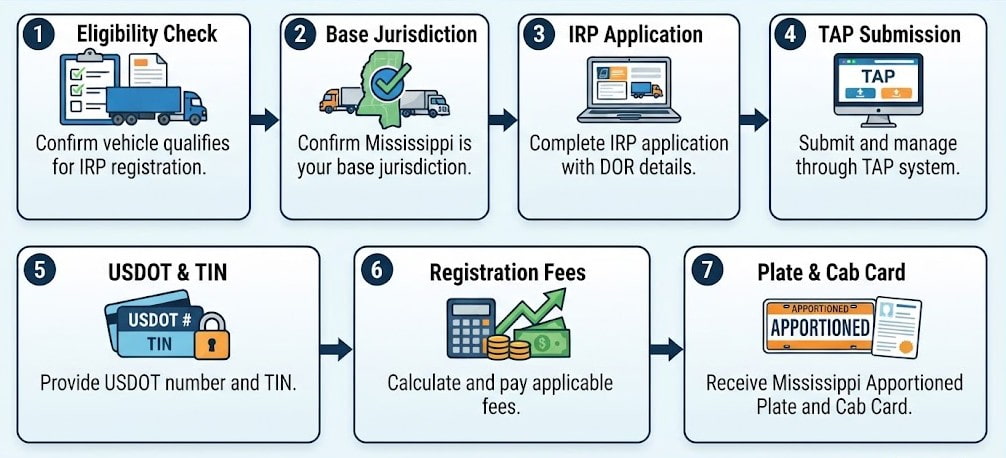
- Eligibility Check: This information is for determining whether a commercial vehicle qualifies for IRP registration and apportioned registration.
- Base Jurisdiction: This section is for confirming whether Mississippi can serve as the carrier’s IRP base jurisdiction.
- IRP Application: This information is for completing the IRP application and providing the vehicle, carrier, and registration details required by Mississippi DOR.
- TAP Submission: Taxpayer Access Point (TAP) is used for submitting IRP applications and handling vehicle additions or removals from an existing IRP account.
- USDOT & TIN: These requirements are for providing the carrier’s USDOT number and Taxpayer Identification Number (TIN) during the IRP registration process.
- Registration Fees: This information is for determining and paying the applicable apportioned registration fees.
- Plate & Cab Card: After registration is processed, the carrier receives the applicable Mississippi Apportioned License Plate and cab card or other required credentials.
Commercial Vehicle Registration Requirements
Commercial vehicle registration in Mississippi requires accurate vehicle, carrier, ownership, and federal identification information. For an IRP registration, the carrier should prepare the records needed to identify the business, vehicle, operating weight, and jurisdictions in which the vehicle will operate. Mississippi DOR requires a valid USDOT number and Taxpayer Identification Number (TIN) for IRP registration. An updated MCS-150 is required for each USDOT number associated with an IRP account. The information submitted on the IRP application should match the carrier’s current records.
Documents for a New Commercial Registration
A new Mississippi commercial registration may require documents that establish vehicle ownership and the transaction.
Records include:
- Vehicle title or title application showing ownership or the pending title transaction.
- Bill of sale, when applicable, to document the purchase or transfer of the vehicle.
- Business or carrier information identifying the registered owner or operating entity.
- USDOT number associated with the carrier.
- TIN used for the IRP account and registration records.
- Current vehicle details, including identification information and registration data.
Additional Documents for IRP Registration
An IRP application requires detailed information about the carrier and vehicle. Applicants should have the vehicle’s registered weight, declared weight by jurisdiction where applicable, and axle information available. Carrier records should accurately reflect the business name, address, USDOT number, TIN, and operating information. Mississippi DOR requires an updated MCS-150 for each USDOT number connected with an IRP account. The MCS-150 provides federal motor carrier information that supports the carrier’s identification and operating record. Applicants may need supporting operational records related to the carrier’s interstate activity and the Mississippi base-jurisdiction requirements.
Title Requirements
A vehicle title is an important document for Mississippi apportioned registration. The Mississippi IRP manual states that a title is required for an apportioned registration. For a first registration, a title application number may be accepted under specified conditions. This allows the registration process to proceed when the permanent title has not yet been issued, provided the applicable Mississippi requirements are met. Before submitting an application, applicants should check that the title information, vehicle identification details, ownership records, weight, and axle data are consistent across the documents. Complete and accurate records can help reduce issues caused by missing or conflicting information during commercial vehicle registration or IRP processing.
B10 License Plates Explained
A B10 Mississippi License Plate is associated with a Mississippi property-carrier registration classification. Current Mississippi Department of Revenue material identifies B-10 as a property-carrier category for vehicles at 10,000 pounds GVW, and the FY2025 DOR report lists “B-10 Property Carriers 10,000 LBS” as a registration category. The DOR specialty-plate system separately lists Blackout B-10, which explains why searches for “B10 tag” can refer to either the registration classification or its blackout plate version.
What Does B10 Mean?
B10 Mississippi License Plates refer to the B-10 property-carrier classification associated with a 10,000-pound gross vehicle weight (GVW) registration category. Mississippi DOR’s current license-tag specifications identify B-10 as a property-carrier tag for vehicles from 6,001 through 10,000 pounds GVW, with the B-10 classification displayed on the plate. The DOR also lists B-10 separately from B16-B80 categories.
B10 Tag Requirements Mississippi
B10 Tag Requirements Mississippi are tied to the vehicle’s registration classification and reported GVW. Mississippi DOR specifications identify the B-10 category for property carriers at the 10,000-pound GVW level. Registration information should accurately reflect the vehicle’s ownership, vehicle identification details, registered weight, and applicable carrier information. Mississippi DOR states that vehicles with GVW of 10,000 pounds or less are registered through the local county Tax Collector, while vehicles over 10,000 pounds have different registration procedures based on whether they operate only within Mississippi or across state lines. Drivers can check Mississippi DMV Locations to find the appropriate county Tax Collector office and confirm the registration procedures for their vehicle.
Does a B10 Tag Mean the Vehicle Is Commercial?
A B10 tag identifies a property-carrier registration category, so it is associated with a vehicle used as a property carrier rather than a standard passenger registration. Mississippi DOR’s current tag specifications specifically label B-10 as a Property Carrier, 6,001 lbs. to 10,000 lbs. GVW category. This does not mean every B10-registered vehicle has an IRP registration. IRP is a separate registration system for qualifying interstate commercial vehicles, with fees apportioned among jurisdictions based on distance traveled. Mississippi DOR states that qualifying interstate trucks may require an IRP license plate and cab card.
B10, B16 and Higher Weight Classes
B10, B16, and higher B-series classifications relate to Mississippi’s truck and property-carrier registration categories. The current DOR specialty-plate listing includes B16-B80, while its license-tag specifications identify B-10 separately for the 10,000-pound property-carrier category. The B-series should not be interpreted from unofficial weight charts alone. Vehicle GVW, registration classification, operating status, and applicable Mississippi requirements determine the proper registration category. The actual classification for a particular vehicle should be confirmed with the Mississippi Department of Revenue or the appropriate county Tax Collector before registration.
Commercial Plate vs. B10 Tag vs. Apportioned Plate
Mississippi commercial registration terms can refer to different parts of a vehicle’s registration. A Mississippi Commercial License Plate relates to the vehicle’s commercial or property-carrier registration category, while a B10 Mississippi License Plate identifies a particular Mississippi classification connected with vehicle weight. An apportioned plate, by comparison, relates to IRP registration for qualifying vehicles operating across participating jurisdictions. These terms can appear together for commercial trucks, but they do not mean the same thing.
| Feature | Mississippi Commercial Plate | B10 Tag | Mississippi Apportioned Plate |
|---|---|---|---|
| Main Purpose | Commercial or property-carrier vehicle registration | Mississippi vehicle weight/classification category | Interstate registration under IRP |
| What It Relates To | Commercial vehicle use and registration type | Weight classification and property-carrier category | Operation across participating IRP jurisdictions |
| GVW / Weight | May affect the applicable commercial classification | Associated with the applicable GVW classification | Registered weight is used for IRP registration and fee calculation |
| Interstate Operation | Does not automatically mean interstate registration | Does not automatically indicate interstate operation | Applies to qualifying interstate commercial vehicles |
| IRP Required? | Not automatically | Not automatically | Required when the vehicle qualifies for IRP |
| Cab Card | Not necessarily an IRP credential | Not an IRP credential by itself | Cab card is an important IRP credential |
| Key Point | Broad commercial registration concept | Specific Mississippi classification | Separate interstate/apportioned registration system |
Fleet License Plate and Fleet Registration
A Mississippi Fleet License Plate relates to vehicles operated as part of a business or organizational fleet. A fleet can contain multiple cars, trucks, vans, or other vehicles under common ownership or control. Fleet registration and IRP registration are different concepts, although a commercial fleet can contain vehicles that qualify for apportioned registration.
What Is a Fleet Vehicle?
A fleet vehicle is generally a vehicle operated as part of a group of vehicles belonging to or controlled by the same business or organization.
Examples include:
- Delivery trucks
- Company service vehicles
- Business vans
- Corporate cars
- Transportation vehicles
- Multiple commercial trucks operated by one company
A corporate fleet can include vehicles with different uses and registration classifications.
The applicable Mississippi plate depends on factors such as:
- Vehicle type
- Vehicle use
- Ownership
- Gross vehicle weight (GVW)
- Registered weight
- Operating area
- Applicable Mississippi registration category
Fleet Registration vs. Apportioned Registration
Fleet registration covers multiple vehicles operated by the same business or organization, while apportioned registration applies to qualifying commercial vehicles operating across multiple IRP jurisdictions. A fleet vehicle does not automatically require IRP registration; eligibility depends on its operation and applicable requirements.
These two registration concepts have different purposes:
- Fleet Registration: Relates to managing multiple vehicles operated by the same business or organization.
- Commercial Fleet: A group of vehicles used for business or commercial activities.
- IRP Registration: Applies to qualifying commercial vehicles operating in multiple participating jurisdictions.
- Apportioned Registration: Allows qualifying interstate vehicles to be registered under IRP, with registration apportioned among applicable jurisdictions.
- Mississippi Fleet License Plate: Should not automatically be treated as an IRP or apportioned plate.
Can a Fleet Vehicle Also Be Apportioned?
Yes, a fleet vehicle can also have apportioned registration if it meets Mississippi’s IRP requirements. A company may have several fleet vehicles, with only those used in qualifying interstate operations registered under IRP.
For example:
- A company operates 10 commercial trucks.
- Some trucks operate only within Mississippi.
- Other trucks travel across state lines.
- The Mississippi-only vehicles may use applicable Mississippi registration classifications.
- Qualifying interstate trucks may require IRP registration and an apportioned plate.
- The company can therefore have both regular fleet vehicles and apportioned fleet vehicles.
IRP Plate, Cab Card and Registration Credentials
A Mississippi IRP plate is issued to qualifying commercial vehicles registered under the International Registration Plan for interstate operations. The plate works with the cab card and other registration credentials to show the vehicle’s registration status, registered weight, and applicable IRP jurisdictions.
Apportioned Plate
A Mississippi IRP apportioned plate is issued to a qualifying commercial vehicle registered under the International Registration Plan. The plate identifies the vehicle as an apportioned vehicle and supports interstate operation in participating IRP jurisdictions.
Cab Card
The cab card is the main IRP registration document carried inside the vehicle. It identifies the vehicle and lists important details such as the registered weight, vehicle information, and jurisdictions where the vehicle has apportioned registration. It may be reviewed during roadside enforcement.
Registration Credentials
Registration credentials include the apportioned tag, applicable decals, and cab card issued through the IRP registration process. These credentials provide evidence of valid registration and should remain with the vehicle during interstate travel so the carrier can present the required information during an inspection.
Commercial & Apportioned Plate Renewal
Mississippi commercial and apportioned plate renewal depends on the vehicle’s registration category, IRP account status, and applicable registration period. Commercial, fleet, and apportioned vehicles follow requirements that can differ from ordinary passenger vehicle renewals. Carriers should keep their registration information, vehicle details, and required credentials current throughout the registration year.
Commercial Plate Renewal
Commercial plate renewal keeps a qualifying business or commercial vehicle’s Mississippi registration current for the applicable registration period. Renewal requirements can depend on the vehicle classification, registered weight, ownership, and type of commercial operation, so the process may differ from standard passenger vehicle renewal.
Commercial plate renewal may involve:
- Current vehicle registration information
- Vehicle ownership and identification details
- Applicable registration fees
- Registered or declared weight
- Current business or carrier information
- Required registration credentials
Apportioned Plate Renewal
For a Mississippi Apportioned License Plate, renewal is connected with the carrier’s IRP account.
The process may require updated:
- Vehicle information
- Registered weight
- IRP jurisdictions
- Mileage or reporting information
- Carrier information
- Registration credentials
Mileage and Reporting Information
IRP registration uses information related to vehicle operation and jurisdictions.
During renewal, carriers may need to provide or update:
- Reported mileage
- Jurisdiction information
- Vehicle additions or removals
- Weight information
- Other IRP account details
Staggered Registration
Commercial and apportioned registrations should not be treated the same as ordinary passenger vehicle tags. Mississippi registration periods can vary by registration category, so the applicable renewal date should be checked against the vehicle’s current registration and Mississippi DOR requirements.
Commercial Plates vs. Apportioned Plates in Mississippi
Mississippi commercial and apportioned plates serve different registration purposes. The correct category depends on how the vehicle is used, where it operates, its weight, and whether it meets IRP requirements. A commercial vehicle used only within Mississippi may follow the state’s applicable commercial or weight-based registration rules. A qualifying commercial vehicle that travels interstate may need apportioned registration through IRP.
| Feature | Commercial Plate | Apportioned Plate |
|---|---|---|
| Main Purpose | Used for qualifying commercial vehicles under Mississippi registration rules | Used for qualifying commercial vehicles registered through IRP for interstate operations |
| Commercial Use | Yes, intended for business or commercial vehicle use | Yes, applies to qualifying commercial vehicles |
| Interstate Operation | Not automatically required for interstate travel | Designed for qualifying interstate commercial operations |
| IRP Requirement | Not automatically connected with IRP | Connected with Mississippi IRP registration |
| Registration Basis | Vehicle type, use, weight, and applicable Mississippi classification | IRP requirements, vehicle details, jurisdictions, and registered weight |
| Weight Classification | May determine the applicable commercial registration category | Registered weight is part of the IRP registration information |
| Fleet Vehicles | A commercial vehicle may be part of a business fleet | A qualifying fleet vehicle may be registered under IRP |
| B10 Tag | May relate to Mississippi weight or vehicle classification | A B10 classification does not automatically mean the vehicle needs IRP |
| Cab Card | Not an IRP cab card requirement simply because the vehicle is commercial | IRP registration includes a cab card showing applicable vehicle and jurisdiction information |
Adding, Removing or Changing a Vehicle in an IRP Fleet
Managing a Mississippi fleet under IRP requires carriers to keep vehicle and registration information current. Changes to an IRP fleet may involve adding a vehicle, removing a vehicle, changing the registered weight, or replacing registration credentials. Mississippi IRP procedures use supplements for several of these vehicle and registration changes.
Adding a Vehicle
When a carrier needs to add a vehicle to an IRP account, the required vehicle information and supporting documentation must be provided through the applicable IRP process. The vehicle is then added to the carrier’s apportioned registration records.
Removing a Vehicle
To remove a vehicle from an IRP fleet, the carrier submits the applicable supplement and provides the required vehicle and registration information. Removing a vehicle keeps the IRP account aligned with the carrier’s current fleet.
Changing Registered Weight
A change in registered weight may require an IRP supplement. The updated weight information should match the vehicle’s applicable registration records and IRP requirements.
Replacing Credentials
If IRP registration credentials are lost, damaged, or require replacement after a vehicle change, the carrier may need replacement credentials through the applicable Mississippi IRP process.
IRP Supplements for Fleet Changes
An IRP supplement is used to report certain changes to an existing IRP account. Depending on the transaction, supplements can support vehicle additions, removals, and weight changes within the Mississippi IRP fleet.
IRP vs. IFTA for Commercial Vehicles
IRP and IFTA apply to different parts of interstate commercial vehicle operations. IRP deals with apportioned registration, allowing qualifying vehicles to be registered for operation across participating jurisdictions. IFTA deals with fuel tax reporting for qualified motor carriers operating in multiple jurisdictions. A carrier may need one, the other, or both depending on its vehicles, operations, and applicable requirements.
| Feature | IRP | IFTA |
|---|---|---|
| Full Name | International Registration Plan | International Fuel Tax Agreement |
| Main Purpose | Apportioned vehicle registration | Fuel tax reporting |
| Applies To | Qualifying commercial vehicles operating across participating jurisdictions | Qualifying interstate carriers operating across participating jurisdictions |
| Primary Focus | Vehicle registration and apportionment | Fuel use and fuel tax |
| Registration | Provides apportioned registration for qualifying vehicles | Does not provide vehicle registration |
| Apportioned Plate | Yes, applicable vehicles receive apportioned registration credentials | No |
| Registered Weight | Part of IRP registration information | Not the primary purpose |
| Mileage | Used for IRP apportionment and reporting | Used to calculate fuel-tax obligations by jurisdiction |
| Fuel Tax | Does not primarily handle fuel-tax reporting | Handles fuel-tax reporting |
| Cab Card | IRP registration includes a cab card | Not an IFTA registration document |
| Reporting | IRP registration and applicable mileage information | Periodic fuel-use and fuel-tax reporting |
| Can a Carrier Need Both? | Yes | Yes |
Frequently Asked Questions
Mississippi commercial license plates, B10 tags, weight classifications, and apportioned registration. It explains how these plate categories differ, what they are used for, and when IRP registration may apply to qualifying commercial vehicles operating across jurisdictions.
What is a commercial license plate in Mississippi?
Mississippi Commercial License Plates are registration plates used for vehicles that qualify for commercial registration under Mississippi requirements. The applicable registration category can depend on the vehicle’s type, use, weight, ownership, and operation. A commercial plate does not automatically mean the vehicle requires IRP registration or an apportioned plate. Interstate operation and other applicable requirements determine whether additional registration programs apply.
What is a B10 tag in Mississippi?
B10 Mississippi License Plates refer to a Mississippi vehicle registration classification associated with a particular weight or vehicle category. The B10 designation should be considered within the state’s registration and weight classification system. A B10 tag is not automatically an IRP or apportioned plate. The vehicle’s registration records and applicable Mississippi requirements determine the classification that applies.
What are the B10 tag requirements in Mississippi?
B10 Tag Requirements Mississippi depend on the vehicle’s applicable registration classification, vehicle information, and registered weight. The carrier or owner may need to provide vehicle and ownership information and pay the applicable registration fees. Since weight classifications can affect registration requirements, the B10 category should be confirmed against current Mississippi DOR requirements before completing registration or changing a vehicle’s classification.
Is a B10 tag the same as an apportioned plate?
No. A B10 tag and an apportioned plate serve different registration purposes. A B10 designation relates to Mississippi vehicle or weight classification, while an apportioned plate is associated with qualifying interstate commercial vehicle registration through IRP. A vehicle having a B10 classification does not automatically mean that it qualifies for or requires IRP registration.
What is a Mississippi apportioned license plate?
A Mississippi Apportioned License Plate is issued through the International Registration Plan for qualifying commercial vehicles operating across participating jurisdictions. IRP registration is based on applicable vehicle information, registered weight, jurisdictions, and other requirements. An apportioned vehicle receives registration credentials that can include an apportioned plate and cab card. IRP registration is separate from Mississippi-only commercial or weight classifications.